
 Written by
Application Deadline: 7 November 2026
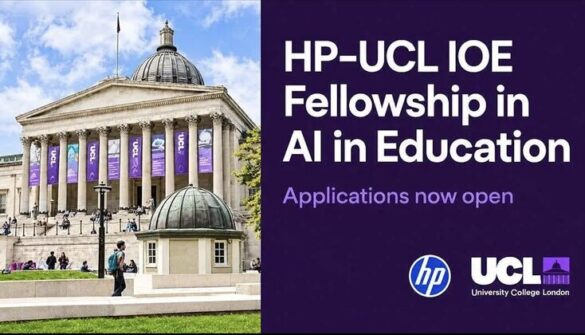
Applications are now open for the HP-UCL IOE Fellowship in AI in Education, an international leadership programme designed for senior education policymakers, government officials and organisational leaders who want to guide the responsible adoption of artificial intelligence (AI) in education.
Delivered through the expertise of UCL Institute of Education (IOE) and its collaborators, the fellowship aims to equip education leaders with the knowledge, governance frameworks and strategic skills needed to integrate AI responsibly into education systems and public institutions.
The programme brings together experts in artificial intelligence, learning sciences, policy, ethics and human-computer interaction. Fellows explore practical case studies, engage with international peers and develop strategies for addressing real-world challenges associated with AI adoption.
The fellowship is particularly relevant as education institutions increasingly consider how AI can improve learning, strengthen inclusion, support decision-making and build institutional capacity while addressing risks involving fairness, transparency and accountability.
Overview of the HP-UCL IOE Fellowship
- Programme: HP-UCL IOE Fellowship in AI in Education
- Host institution: UCL Institute of Education
- Programme duration: 12 months
- Programme format: Hybrid, combining online learning, mentoring and an in-person residential experience
- Application deadline: 7 November 2026
- Programme start date: 11 January 2027
- Residential location: London, United Kingdom
- Eligible regions: Europe, Asia and Africa
- Funding: Programme costs covered for accepted participants, excluding airfares and visa expenses
About the Fellowship
The HP-UCL IOE Fellowship is a selective executive leadership programme for professionals responsible for shaping education policy, managing education systems or making strategic decisions about AI implementation.
Rather than focusing exclusively on AI tools and their technical capabilities, the fellowship examines how education leaders can evaluate AI solutions, develop effective governance structures and make evidence-informed decisions before adopting or expanding AI systems.
Participants learn through expert-led workshops, collaborative discussions, applied activities, leadership clinics and independent study. They also engage with international policy frameworks, emerging research and practical examples of AI implementation.
A central component is the nine-month mentored capstone project, which allows each fellow to address a real policy or implementation challenge within their own organisation.
Eligibility Requirements
The fellowship is intended primarily for senior professionals and decision-makers working across education, government and the public sector.
It is particularly suitable for the following groups:
1. Senior education policymakers
Officials working in ministries of education, government departments and national agencies who influence education policy and AI adoption.
2. Regulators and inspectorate leaders
Professionals responsible for education quality, assessment, inspection or education-related data governance.
3. Senior leaders in education technology
C-suite executives and senior decision-makers at international education technology companies.
4. Officials at international organisations
Senior professionals working on education policy, AI governance or related initiatives within international organisations.
5. Regional and local education leaders
Directors of Education, Directors of Children’s Services and other leaders responsible for education delivery at regional or local levels.
6. School system leaders
Chief executives and directors of multi-academy trusts, school groups and other organisations managing multiple schools.
7. Education non-profit and professional organisation leaders
Senior leaders in education-focused non-profits, foundations, professional bodies, teacher organisations and school-leadership unions.
Important: The programme is designed for experienced leaders rather than general applicants seeking an introductory AI course. Applicants should consult the official fellowship page for the complete eligibility criteria and application requirements.
Benefits of the HP-UCL IOE Fellowship
The fellowship offers professional development, practical experience and access to an international community of education leaders.
1. Programme funding
The programme covers its costs for participants upon acceptance, with airfares and visa expenses excluded.
Accommodation and catering are provided during the programme’s covered hours. Participants are responsible for travel costs associated with the residential component and evening meals in London, as specified in the programme information.
Applicants should review the official terms carefully to understand which expenses they must cover personally.
2. Learn from leading academics and experts
Fellows engage with academic experts whose research and work inform international AI and education policy. The programme connects participants with perspectives associated with organisations such as UNESCO, the OECD, the Council of Europe and the European Commission.
This exposure helps leaders understand the policy, ethical and practical considerations involved in introducing AI into education systems.
3. Develop practical AI governance skills
The curriculum covers key areas including:
- AI ethics, fairness and accountability
- AI governance and transparency
- Procurement and assessment of AI solutions
- Evidence-based decision-making
- Evaluating AI impact claims
- Responsible implementation and scaling of AI initiatives
These skills can help participants question vendor claims, evaluate potential risks and make more informed decisions about education technology investments.
4. Complete a mentored capstone project
A major benefit is the nine-month mentored capstone project, which focuses on a live challenge within the fellow’s organisation.
Possible outputs could include an AI strategy, a procurement framework or a policy design, depending on the challenge selected.
The project is intended to help fellows translate what they learn into practical recommendations and organisational improvements.
5. Build an international professional network
Participants collaborate with senior leaders, researchers and practitioners from different countries and professional backgrounds.
After completing the programme, alumni can join a global network of fellows, providing opportunities for continued professional exchange and collaboration.
6. Strengthen leadership and change management
Responsible AI adoption involves more than selecting the right technology. It also requires stakeholder engagement, organisational readiness, effective communication and sound implementation decisions.
The fellowship helps leaders develop the frameworks and language needed to advise their organisations and guide complex AI-related change.
Benefits to Participating Organisations
The programme is also designed to deliver value to the organisations represented by fellows.
Practical organisational outputs: The capstone project focuses on a real challenge, allowing participants to develop work relevant to their organisation’s needs.
Better procurement decisions: Fellows develop skills for assessing AI vendor claims, comparing solutions and evaluating potential impact before committing substantial resources.
Defensible AI governance: Participants learn to assess AI systems using fairness, transparency and accountability frameworks, helping organisations explain and justify their decisions.
Evidence-informed investment: The programme helps leaders assess whether reported AI results are relevant to their own context before expanding pilot projects.
Stronger implementation leadership: Fellows gain frameworks for managing AI-related change and engaging the different stakeholders affected by implementation.
Access to global policy perspectives: Participants learn from academic and policy expertise while exchanging ideas with international leaders facing similar challenges.
Programme Structure and Duration
The fellowship is a selective, 12-month hybrid programme combining online learning, independent study, coaching, mentoring and an in-person residential experience.
The programme is organised around three main components:
Phase 1: Online workshops and leadership development
The first three months feature live online workshops supported by independent study and coaching.
Participants explore AI in education, governance, policy, ethics and practical implementation through expert-led learning and collaborative discussion.
Phase 2: Mentoring and capstone project
The following nine months focus on a mentored capstone project addressing a real challenge from the participant’s professional environment.
A facilitator guides the project, and the programme includes two follow-up calls with each fellow.
Phase 3: Residential week in London
The programme also includes a one-week residential experience in London, providing an opportunity for in-person learning, engagement and collaboration.
Participants are expected to commit fully to all programme components.
Application Timeline
Applicants should note the following dates provided in the programme announcement.
| Event | Date |
|---|---|
| Application deadline | 7 November 2026 |
| Notification of outcomes | 16 November 2026 |
| Programme begins | 11 January 2027 |
| UCL Easter closure | 25–30 March 2027 |
| Residential week in London | Week beginning 5 April 2027 |
Dates and programme arrangements should be confirmed through the official website before applying or making travel plans.
How to Apply for the HP-UCL IOE Fellowship
Interested candidates should follow these steps:
- Visit the official fellowship webpage: Read the programme description, eligibility requirements and application guidance carefully.
- Assess your eligibility: Determine whether your current role and leadership responsibilities align with the fellowship’s focus on education policy, organisational leadership and responsible AI adoption.
- Prepare your application: Gather the information and supporting materials requested in the official application process.
- Explain your organisational challenge: Consider a relevant AI policy or implementation issue that you could address through the nine-month capstone project.
- Submit before the deadline: Complete the application according to the official instructions before 7 November 2026.
Applicants should ensure they can participate in the online sessions, mentoring activities and London residential component before committing to the programme.
Frequently Asked Questions
1. Is the HP-UCL IOE Fellowship fully funded?
The programme covers its costs for accepted participants, but airfares and visa expenses are excluded. Participants should also account for the travel costs and evening meals in London identified in the programme information.
2. Who should apply?
The fellowship is intended for senior education policymakers, regulators, education system leaders, executives in education technology, international organisation officials and leaders of education-focused non-profits and professional bodies.
3. Is the programme conducted entirely online?
No. It is a hybrid programme that combines live online workshops, independent study, coaching, mentoring, a capstone project and a one-week residential experience in London.
4. How long does the fellowship last?
The programme lasts 12 months. It begins with three months of online workshops and continues with nine months of mentoring and capstone work.
5. When does the programme begin?
The stated start date is 11 January 2027.
6. What is the application deadline?
The announced deadline is 7 November 2026. Applicants should verify the deadline and any submission requirements on the official website.
Final Thoughts
The HP-UCL IOE Fellowship in AI in Education offers a professional development opportunity for experienced leaders who want to shape how artificial intelligence is governed and implemented in education.
Its combination of international expertise, leadership development, AI governance training and a mentored organisational project makes it particularly relevant to professionals responsible for education policy, institutional strategy and education technology adoption.
For eligible leaders in Africa, Asia and Europe, the fellowship provides an opportunity to develop practical approaches to responsible AI transformation while building relationships with peers and experts from around the world.
Ready to apply?
Visit the official webpage for full details, eligibility criteria and application instructions:
Disclaimer: This article is based on the supplied programme information. Programme details, eligibility requirements, funding arrangements and deadlines should be confirmed directly with UCL before applying.