
 Written by
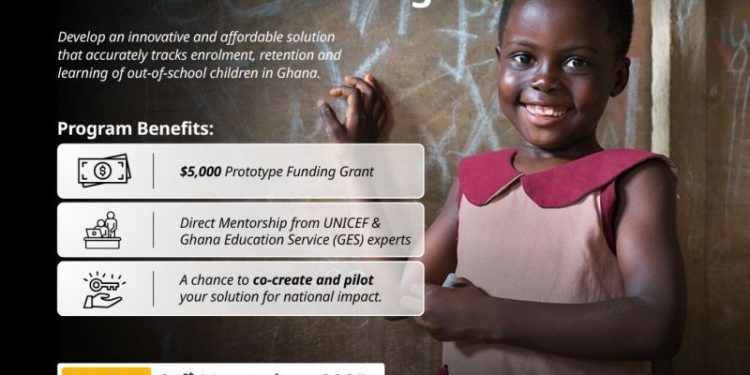
 Are you an innovator, social entrepreneur, or startup working on education solutions? UNICEF is calling for submissions to its StartUp Lab Education Challenge 2025, focused on designing tech-driven, inclusive models for out-of-school children in Ghana. This is your chance to build real-world solutions, secure funding, and help bring children back into learning pathways.
Despite progress, hundreds of thousands of primary-age children remain out of school in Ghana, especially in marginalized and underserved communities. UNICEF and its partners aim to change this by supporting inclusive, data-powered, and locally driven innovations that help identify, monitor, retain, and educate these children.
The challenge encourages low-cost, community-based solutions that tackle root causes such as poverty, disability, and rural isolation.
What’s on Offer / Benefits
- US$ 5,000 prototype grant to help build and test your solution.
- Mentorship from UNICEF experts and the Ghana Education Service (GES).
- Opportunities to pilot and co-create your solution with UNICEF and national stakeholders.
- Platform to influence national-level education systems and potentially scale your solution.
Who Can Apply (Eligibility)
- Innovators, social entrepreneurs, startups, or NGOs working on education-related innovations.
- Solutions must be inclusive, addressing children who remain out of school — including those with disabilities, girls, or children in remote areas.
- Ideas need to be affordable, scalable and community-driven, ensuring long-term sustainability and alignment with national systems.
- Must be based (or operate) in Ghana, to align with the Ghana Education Service’s role in the challenge.
Key Dates & Application
- Deadline for application: 21 November 2025
- How to apply: Use the Google Forms link:
👉 UNICEF StartUp Lab Education Challenge Application
Tips for Applicants
- Use real data: Clearly show how many children in your target area are out of school, and explain how your innovation will reach and help them.
- Focus on inclusion: Highlight how your solution will cater to girls, children with disabilities, and those in rural or marginalized communities.
- Design for scale: Explain how your idea can grow or be adopted nationally. Propose a realistic model for scaling.
- Be cost-conscious: Low-cost tools and sustainable financing make your idea more attractive.
- Build partnerships: Show how you plan to work with schools, community groups, local governments, or education authorities.
- Prepare a strong prototype plan: Use the prototype grant to test with real users; outline a clear pilot plan.