
 Written by
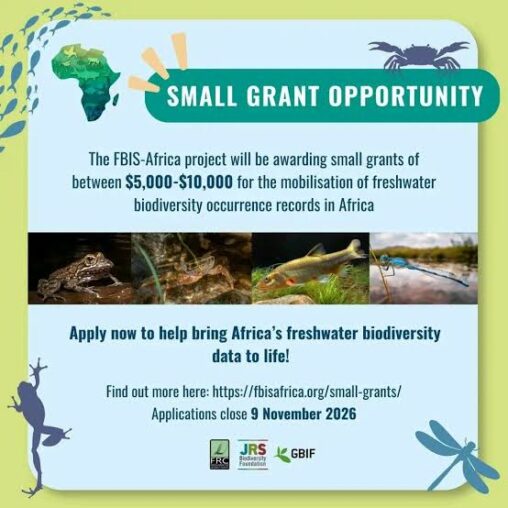
The Freshwater Biodiversity Information System for Africa (FBIS Africa) is inviting applications for small grants of US$5,000 to US$10,000 to help researchers and institutions organise, digitise and publish existing freshwater biodiversity data from across Africa.
The initiative is led by the Freshwater Research Centre, with support from the JRS Biodiversity Foundation and the Global Biodiversity Information Facility’s Biodiversity Information for Development (BID) programme.
The grants will support the preparation of unpublished biodiversity records for publication on the FBIS Africa platform and the Global Biodiversity Information Facility (GBIF), making the information accessible for research, freshwater conservation and environmental decision-making.
Applications close on November 9, 2026. Successful applicants will carry out their projects over six months, from January to June 2027.
What the Grants Cover
Successful applicants can request between US$5,000 and US$10,000 to prepare existing freshwater biodiversity records for publication.
Eligible activities include:
- Data collation and digitisation: Bringing together existing records and converting paper-based information into digital formats.
- Data cleaning and quality control: Checking records for errors, inconsistencies and missing information.
- Georeferencing: Adding or verifying geographic coordinates associated with species observations or collections.
- Metadata preparation: Documenting the source, collection methods and other relevant information about datasets.
- Formatting and standardisation: Preparing datasets for submission using the required data structure and standards.
- Other data preparation costs: Reasonable expenses directly related to making eligible datasets ready for publication.
The grants are intended to mobilise existing data, rather than fund new biodiversity surveys or general research unrelated to preparing eligible records for publication.
Who Can Apply?
Applications are open to African freshwater biodiversity data holders, including:
- Universities and research institutions.
- Museums and natural history collections.
- Government agencies.
- Non-governmental organisations.
- Freshwater biodiversity programmes.
- Individual researchers and data custodians working through eligible host institutions.
Applicants must have access to relevant freshwater biodiversity records and demonstrate clear ownership or custodianship, including permission to publish the data.
Eligible Biodiversity Data
The proposed datasets must contain freshwater biodiversity occurrence records from Africa that have not already been published on GBIF.
Eligible taxonomic groups include:
- Freshwater fishes.
- Amphibians.
- Molluscs.
- Crustaceans.
- Odonata (dragonflies and damselflies).
- Ephemeroptera (mayflies).
- Plecoptera (stoneflies).
- Trichoptera (caddisflies).
- Megaloptera (aquatic insects including dobsonflies and fishflies).
Each occurrence record must contain at least three essential details: the taxon name, sampling date and geographic coordinates (latitude and longitude).
Additional information, such as species abundance, sampling methods, photographs, habitat measurements and water-quality data, can strengthen a dataset but is not compulsory.
What Successful Applicants Must Do
Grant recipients will be required to:
- Specify the number of unpublished occurrence records they intend to mobilise.
- Sign the FBIS Africa Data Sharing Agreement.
- Prepare datasets using the official FBIS Africa Data Upload Template.
- Submit completed datasets and associated metadata to FBIS Africa.
- Agree to have the funded records published on FBIS Africa and shared with GBIF.
- Complete the required technical and financial reports.
The FBIS Africa team will provide assistance with the data preparation process.
How Applications Will Be Evaluated
Applications will be assessed using four main criteria.
Data quality Reliability, taxonomic accuracy, completeness, metadata and georeferencing. Data quantity The number of unique occurrence records proposed for publication. Geographic coverage and priority Coverage of underrepresented countries, river basins and freshwater ecosystems. Capacity to deliver Relevant experience, institutional capacity and ability to complete the work within six months.
Additional consideration may be given to historical or irreplaceable datasets, threatened or endemic species, conservation-priority areas, regional collaboration, capacity development and value for money.
Grant Duration
The six-month grant period will run from January to June 2027. Applicants should propose activities that can be completed within this period and demonstrate that they have the capacity to prepare and submit the dataset on schedule.
Application Deadline
November 9, 2026.
Applicants should submit their completed application form and the project leader’s CV before the deadline.
How to Apply
- Visit the official FBIS Africa small grants webpage.
- Download the Africa Freshwater Biodiversity Data Mobilisation Small Grant Application Form.
- Complete the form with a short project motivation, dataset details, the number of records, geographic coverage and proposed data mobilisation activities.
- Attach the project leader’s CV.
- Email both documents to nazley@frcsa.org.za using the subject line
FBIS-Africa small grant application submission.
Funding available Application deadline November 9, 2026