
 Written by
 The Climate Intervention Environmental Impact Fund (CIEIF) is inviting applications from investigators and organisations developing innovative climate-intervention technologies that are approaching small-scale field testing.
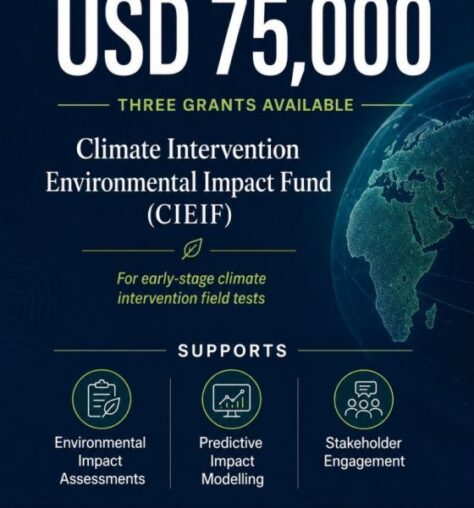
The fund will award three grants of $75,000 each in its sixth grant round. Funding will support environmental impact assessments, predictive impact modelling and stakeholder engagement linked to proposed climate-intervention field tests.
The application deadline is December 1, 2026.
What Is the CIEIF Grant?
The Climate Intervention Environmental Impact Fund supports projects that aim to address the root causes of global warming or its major effects through innovative climate-intervention technologies.
Rather than funding the development or general implementation of a climate project, CIEIF provides grants for the analysis and stakeholder engagement needed to assess the potential environmental, social, economic and health impacts of a proposed field test.
The current funding round will make three awards of $75,000 each.
What Can the $75,000 Grant Fund?
Applicants must show how the funding will be used primarily for at least one of three areas:
- Environmental impact assessment (EIA)
- Predictive environmental impact modelling
- Engagement with potentially affected stakeholders, including communities and government agencies
The grant can cover relevant consultant costs, applicant staff time and closely associated expenses connected to this work.
Selected applicants will receive the first third of the grant after discussions with CIEIF about the expert consulting needs of their proposed field test. The remaining payments will follow an agreed schedule linked to project milestones.
Who Can Apply?
CIEIF accepts applications from qualified investigators and organisations developing innovative climate-intervention technologies that are approaching field testing.
The fund has a global reach and can consider applications from private businesses. However, it gives higher priority to nonprofit institutions, including academic institutions. International projects may receive higher priority where a US nonprofit partner is available to accept the grant as a donation.
Individuals and student projects are not eligible.
What Types of Climate Projects Are Eligible?
CIEIF considers innovative interventions that could potentially be scaled to deliver meaningful climate benefits.
Examples listed by the fund include:
- Biochar
- Enhanced weathering
- Carbon dioxide removal methods other than Direct Air Capture
- Cloud brightening
- Ocean interventions and marine carbon removal
- Methane removal
- Livestock methane capture
- Agricultural climate interventions
- Ice and land albedo enhancement
- Greenhouse-gas-removing coatings
- Black soot removal or mitigation
- Nitrous oxide and chlorofluorocarbon removal
- Other similar climate-intervention technologies
The proposed intervention must be approaching a small-scale field test, rather than remaining at the basic research stage.
What Projects Are Not Eligible?
CIEIF does not provide general implementation or basic research funding.
Projects focused primarily on areas such as:
- Climate adaptation
- Clean energy
- Climate resilience
- General emissions reduction
- Sustainable development
are outside the fund’s scope unless the project involves an eligible climate intervention that addresses a root cause of global warming or its major effects.
The fund also excludes stratospheric or higher solar radiation management, as well as Carbon Capture Utilization and Storage (CCUS) and Direct Air Capture (DAC).
What Must Be Included in the Application?
There is no standard application form or template.
Applicants should prepare a grant request of no more than 20 single-spaced pages, using 12-point font and written in English. Biosketches and important scientific publications can be attached as supplementary material.
The application should address:
- Contact details and biosketches of the project personnel.
- A detailed description of the proposed field test and evidence that the technology is ready for testing.
- Expected technical and environmental challenges.
- Potential economic, social, public health and safety impacts.
- Required government permits and approvals.
- Previous publications relating to the technology.
- At least two independent consulting firms that could support the impact assessment, modelling or stakeholder-related work.
- A proposed budget showing how the $75,000 would be used.
- Other sources of funding for the investigation.
- Relevant insurance arrangements.
- Confirmation that the project’s results can be published.
- Any other important information about the proposed field test.
Important Application Requirement
CIEIF has specifically stated that AI-generated content cannot be used in cover letters or applications.
The organisation says applications will be reviewed for AI use and that applications identified as using AI-generated information will be rejected, with applicants potentially barred from future applications.
For this reason, applicants should prepare their submissions themselves and follow CIEIF’s instructions carefully.
How to Apply
There is no standard online application form.
Once the grant request is ready, applicants should contact Peter T. Jenkins, Manager, CIEIF, at info@CIEIF.org. CIEIF will then discuss the appropriate way to submit the application.
The fund says applications will be kept confidential.
For More Information, Visit the Official website: Climate Intervention Environmental Impact Fund
Deadline
The deadline for the sixth CIEIF grant round is:
December 1, 2026
Grant decisions are expected to be announced by February 1, 2027.
Key Details
Programme: Climate Intervention Environmental Impact Fund
Funding: $75,000 per selected project
Number of grants: 3
Focus: Environmental impact assessment, predictive impact modelling and stakeholder engagement
Geographic scope: Global
Eligible applicants: Qualified investigators and organisations
Priority: Nonprofit and academic institutions
Individuals: Not eligible
Application format: Grant request, maximum 20 pages
Deadline: December 1, 2026
Decision expected: February 1, 2027
Application: Contact CIEIF before submission